Our Product
Precision Fiber Optic Sensors
Explore configurable displacement sensor systems designed for precision measurement in aerospace, vacuum, cryogenic, industrial, and research applications.
LIVE SENSOR ANALYSIS
ENGINEERING PHILOSOPHY
Built for Critical
Measurement Applications
Philtec designs and manufactures precision fiber optic displacement sensors for non-contact measurement in demanding industrial and research environments.
Our sensor systems deliver accurate, high-speed measurements in applications involving vibration, motion, displacement, cryogenics, vacuum systems, and extreme operating conditions.
Proven Experience
35+ Years
Precision Heritage (Est. 1988)
0.76 to 76 mm
Standard Operating Ranges
Up to 10⁻¹¹ Torr
Ultra-High Vacuum Compatibility
Total EMF Immunity
Non-conductive, dielectric glass fiber paths resist high-voltage, lightning, and magnetics.
Fiber optic sensors provide inherent immunity to electromagnetic and radio-frequency interference because the sensing signal is transmitted optically rather than electrically.
Extreme Resiliences
Validated operation from absolute cryogenic liquids to temperatures up to 400°C.
Modular Output Hardware
Equipped with 0-5V analog voltage terminals or high-resolution RS232/USB digital modules.
Custom Geometry Match
Engineered probe shapes, right-angle sheathing, and sapphire window assemblies.
Sensor Technologies
D Model vs. RC Model Optics
We manufacture two baseline optical configurations designed to resolve target behaviors perfectly.
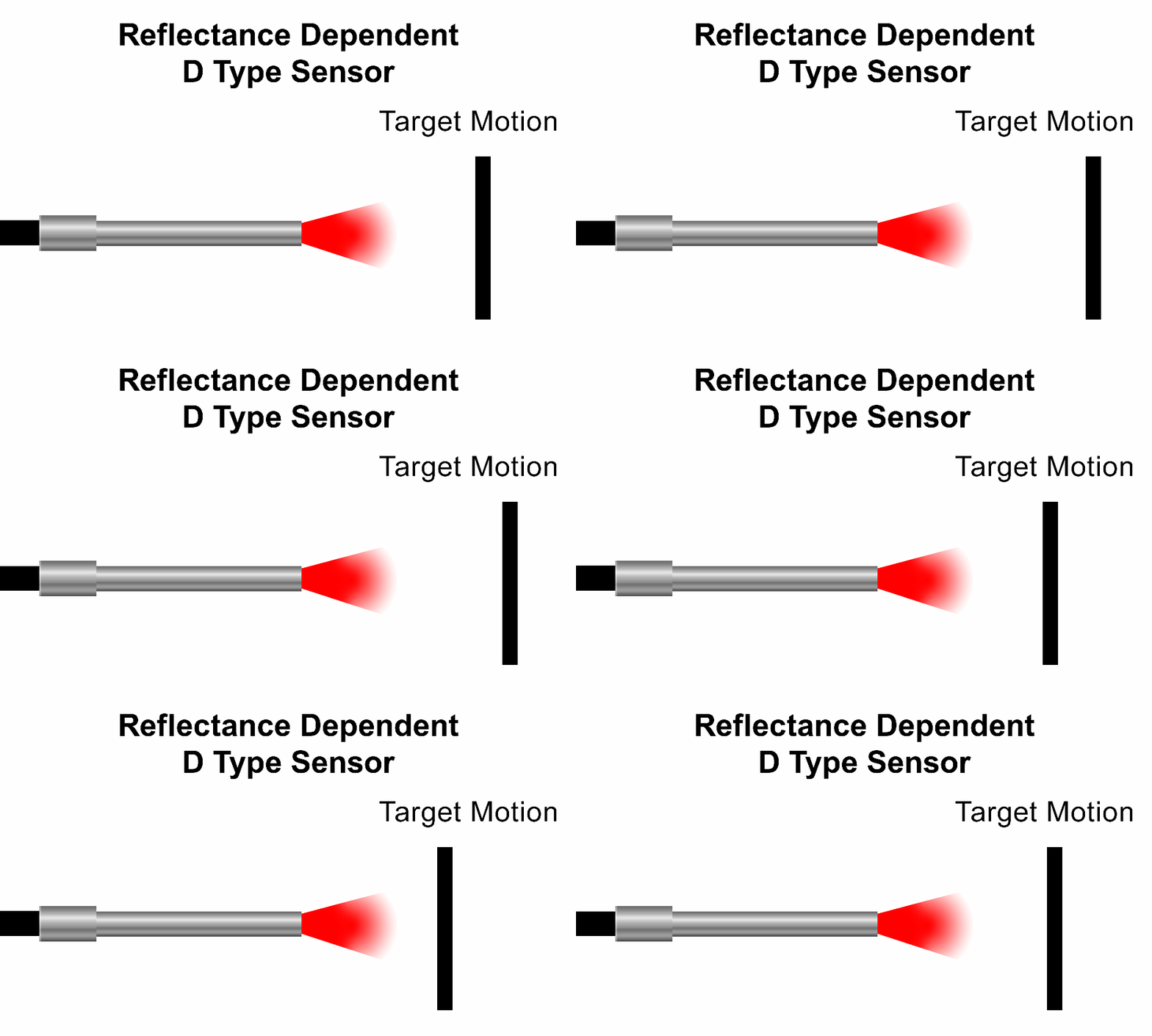
D Model Sensors (Reflectance Dependent)
Reflectance dependent sensor bundles where light emission and receive fibers are completely randomized. Best for extremely fast dynamic operations (up to 1 MHz) parallel to the probe axis.
- Pistons
- Valves
- Single-axis motion
- vibration
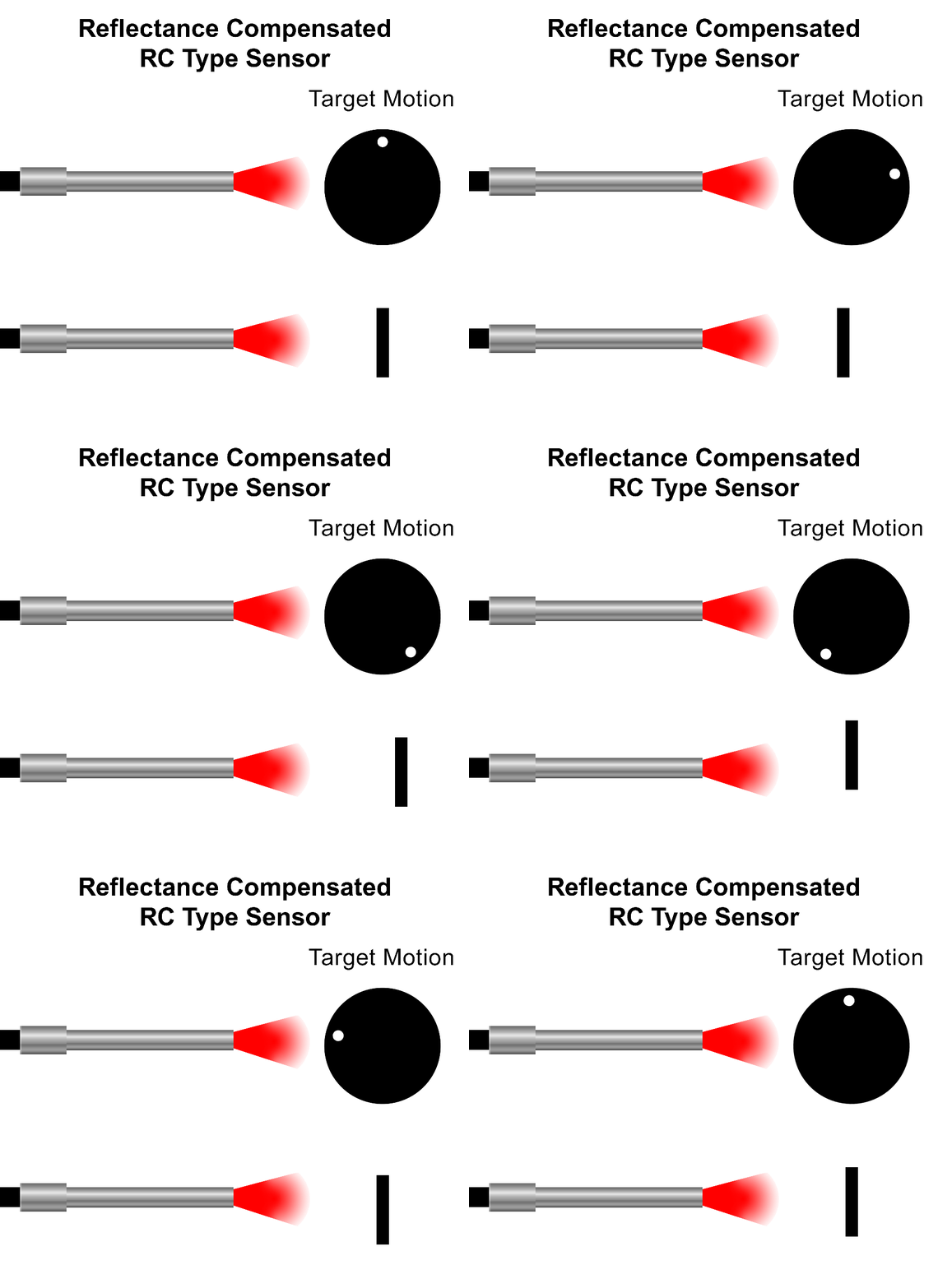
RC Model Sensors (Reflectance Compensated)
Reflectance compensated fiber structures split fibers cleanly into separate emission and receive quadrants. Measures exact target positions accurately even on rotating targets or changing surfaces.
- rotating targets
- varying reflectance
- lateral movement
How to Build a Sensor System
Complete this interactive engineering questionnaire to configure your ideal Philtec sensor architecture.
Target Surface Motion
Target surface movement profiles determine the optimal optics orientation (D vs RC).
Measurement Range Profile
Configure operational range and dynamic bandwidth requirements.
Sensor Tips and Cable Options
Configure sensor tip geometry and cable jacket sheathing.
Vacuum Options and Media
Configure vacuum hardware, operating temperature, and measurement media.
Signal Telemetry & Output Hardware
Select interface electronics and communication architecture.
Submit Engineering Spec
Send your configured sensor specification to the Philtec engineering team.
Specialty Hardware Integration
Custom Probes & Sensor Configurations
No two environments present the same mechanical space constraints. Over 70% of our products undergo custom engineering to interface with target hardware chambers seamlessly.
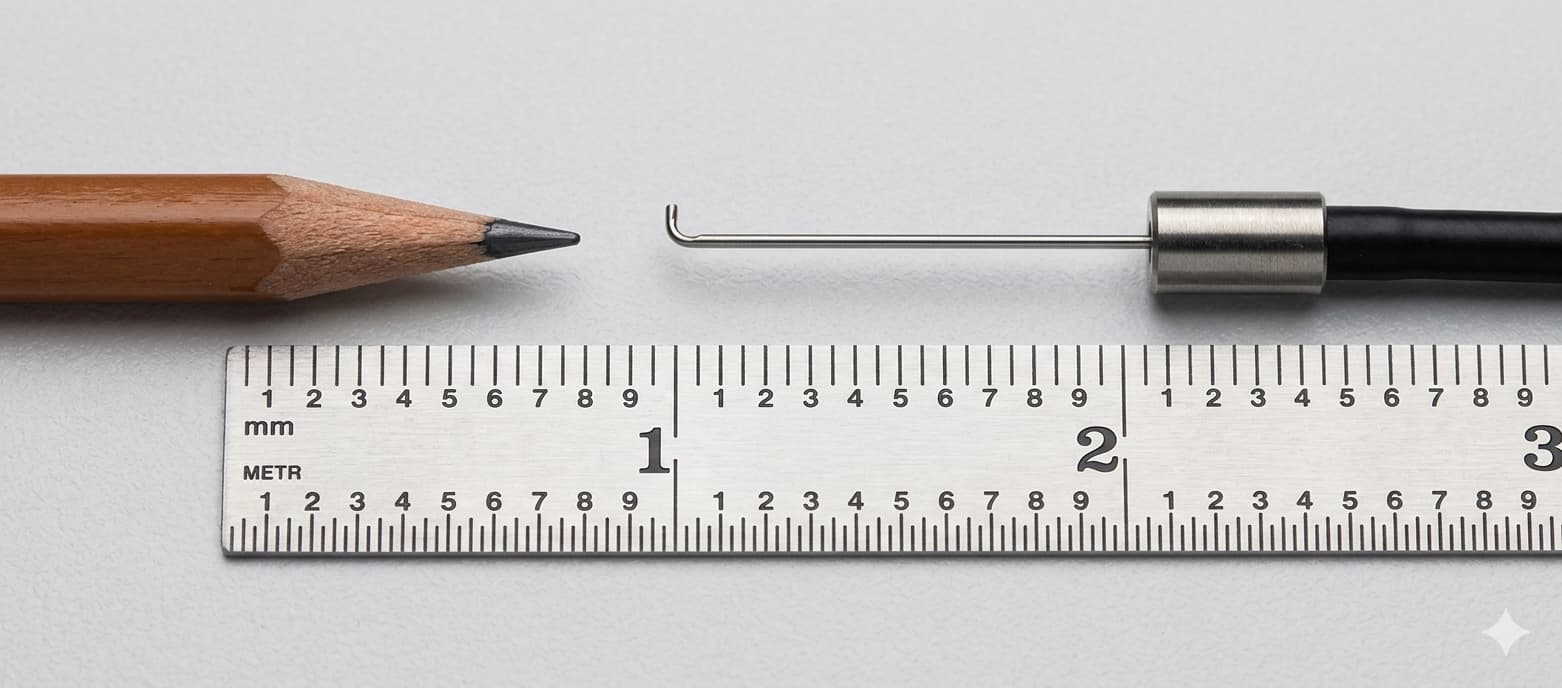
Very Small Probes
Allows fibers to execute tight right-angle bends close to machinery walls or rotating blades without losing signal integrity.
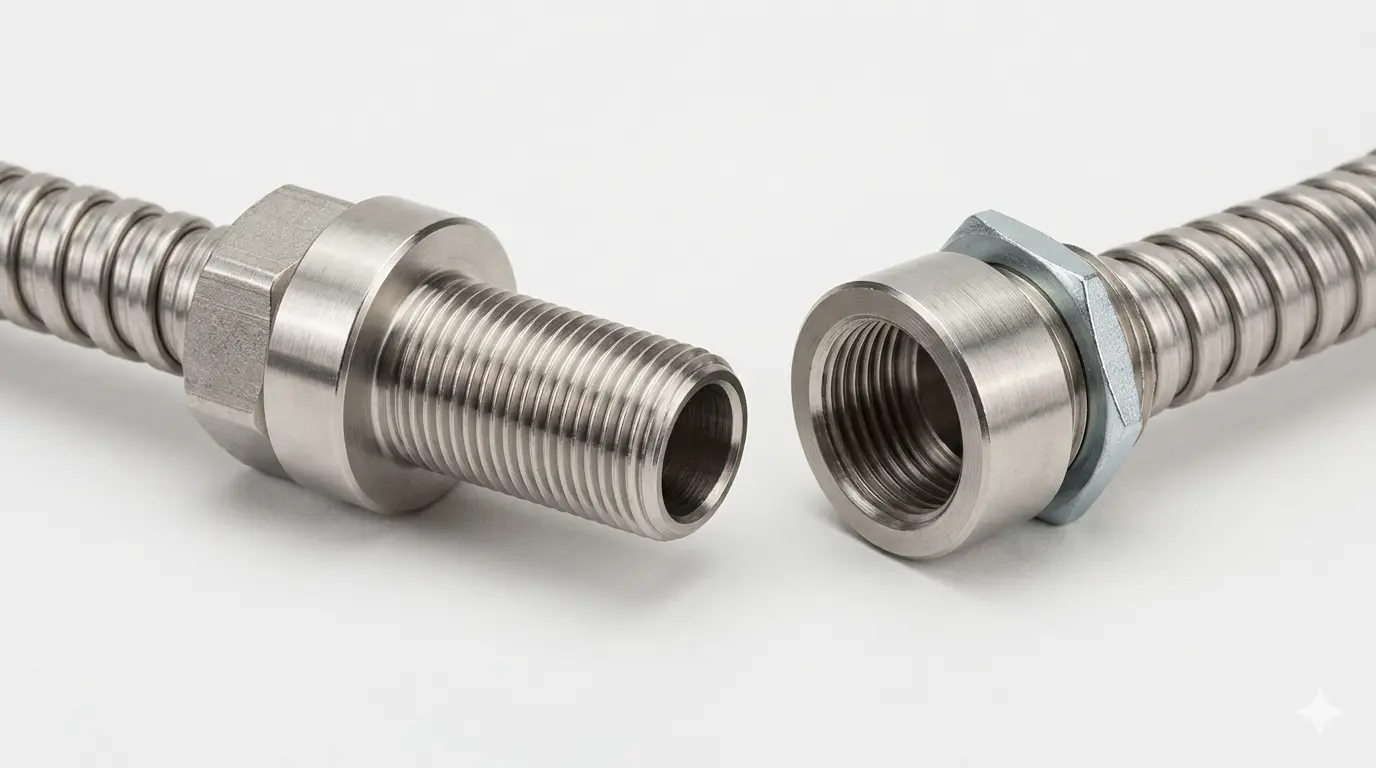
Threaded Probes
Allows fibers to execute tight right-angle bends close to machinery walls or rotating blades without losing signal integrity.
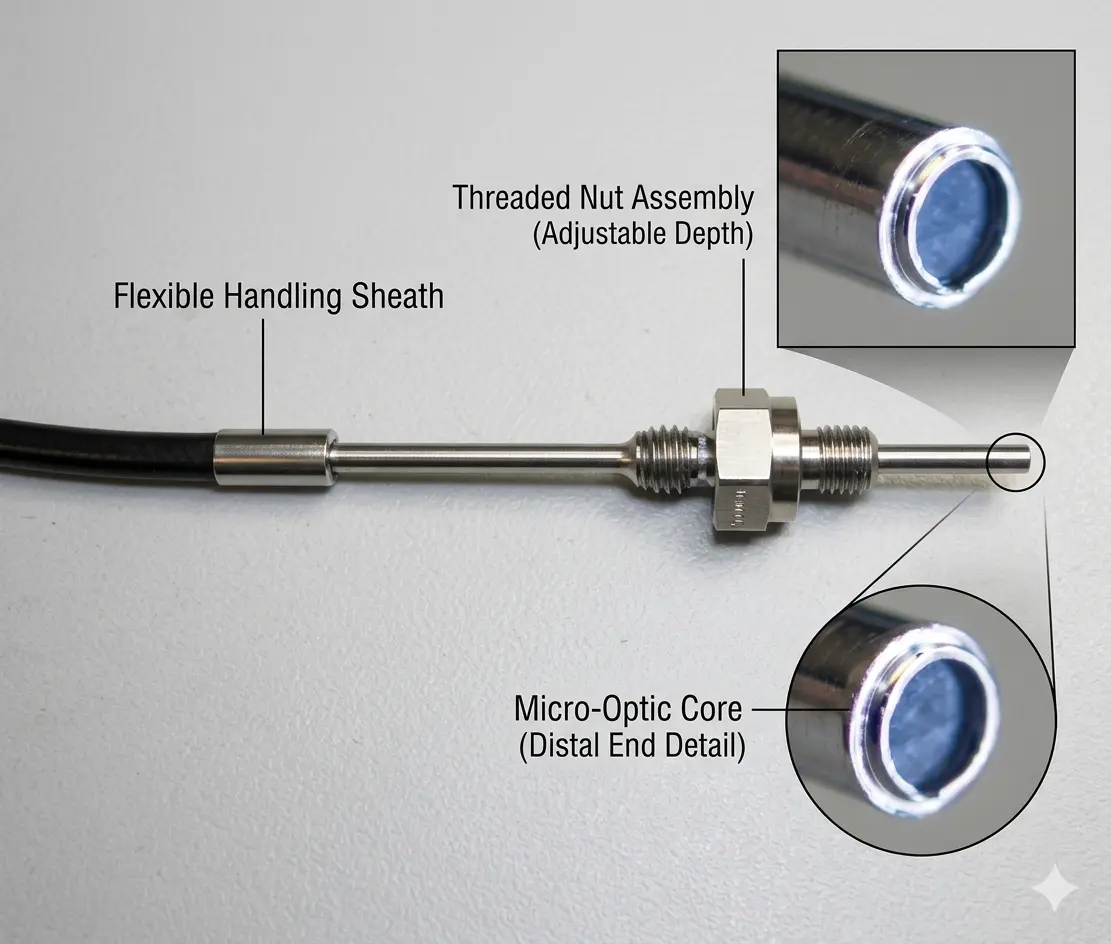
High Pressure Probes
Philtec engineers can assist with the choice and design of high pressure probes.
There are three options for sealing the fibers under high pressure:
- Epoxy filled tips
- Sapphire Windows epoxied into tip counterbores
- Sapphire Windows brazed into tip counterbores
Environmental Extremes
Engineered for Extreme Environments
Where silicon circuits, capacitance grids, and acoustics completely fail, silica fibers continue to measure reliably.
Absolute Cryogenics
Operating continuously submerged in volatile cryogenic liquids including Liquid Nitrogen, Liquid Oxygen, and Liquid Helium, down to single digit Kelvin climates. Optimized for turbo-pump radial bearing and shaft gap diagnostics in space launch launchpads.
Ultra-High Vacuum (UHV)
Features specialized vacuum feedthrough ports and metal-brazed seals (Option Bv2/Bv3/BvF) optimized to sustain vacuum integrity down to $10^{-11}\text{ Torr}$. Outgassing elements are eliminated to maintain pure chamber integrity.
Extreme Thermal Heat
Standard tips function up to $200^{\circ}\text{C}$. Our custom mechanical bond configurations (Option T10) and sapphire window structures (Option Wb) are rated to run continuously in environments up to $800^{\circ}\text{C}$.
Analog 0 to +5V Terminals
Onboard Polynomial Fits
Real-time CSV export
Analog & Digital Acquisition Systems
Select standard single-channel analog units for rapid response measurements (DC up to 20 KHz), or upgrade to digital output systems (RS232 or USB) to perform data logging via Philtec DMS Control Software.
TECHNICAL RESOURCES
Downloads, Specifications & Engineering Support
Access technical documentation, product specifications, software tools, and engineering resources for Philtec fiber optic sensor systems.
Product Data Sheets
Download detailed specifications, operating ranges, resolutions, and enclosure options for D and RC sensor models.
D & RC Specifications
Compare sensor families, measurement ranges, sensitivities, and operating characteristics.
Application Notes
Explore technical guidance and real-world applications for displacement and vibration sensing.
Firmware & Software
Access software utilities, firmware updates, and digital sensor support tools.
User Manuals
Installation guides, operating instructions, and setup documentation for Philtec systems.
Product Catalogs
Browse complete product catalogs and overview brochures for Philtec technologies.
FAQs
Find answers to common questions about sensor selection, setup, and applications.