Sensors for Cryogenic Environments


Designed for liquid hydrogen, liquid oxygen, cryogenic turbopumps, and near-absolute-zero measurements.

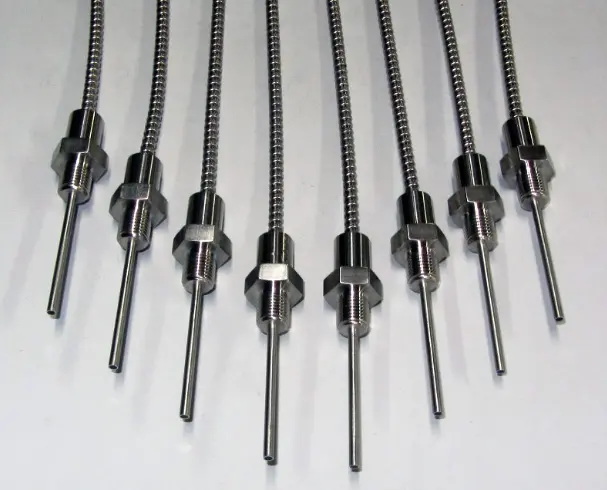
Probes For Cryogenic Turbo Pump

To Measure Shaft Displacements

Operating Environment

  • Liquid Hydrogen (probe tip immersed)
  • Operational Temp: -420°F
  • Non-Op Temp: 0°F to 130°F
  • Pressure: 2500psia (max)

Operating Environment

  • Hydrogen Gas (probe tip immersed)
  • Operational Temp: 40°F
  • Pressure: 1000 psig

Probe tips are immersed in LOX at -300°F and 1,000 psi

Extreme Temperatures

Philtec sensors can be designed for use in extreme high or low temperatures.

Standard Glass Fiber Sensor Tips

Standard sensor tips are constructed with glass fibers, epoxy and stainless steel housings. These standard materials allow operation down to cryogenic temperatures approaching absolute zero. The upper temperature limits are:

200°C continuous
300°C intermittent
Standard, most models
250°C continuous
300°C intermittent
High Temperature Cure, specify Option T8
350°C continuous
400°C intermittent
High Temperature Construction, Specify Option T9

Fiberoptic Cables

Glass and Quartz fibers have a buffer coating that keeps the fibers flexible. That coating burns off starting at 300°C and the fibers will become brittle and easily cracked. The sheathing materials limit the temperature range of the cables as given in the table below. In the most extreme conditions, the glass fibers can be exposed to cryogenic temperatures near absolute zero and elevated temperatures above 300°C (up to 480°C). Fibers exposed to temperatures above 300°C will become very brittle, and therefore, they should not be flexed during or after such exposure. Fibers can be slowly exposed to cryogenic temperatures and returned to room temperature (avoiding thermal shock) without suffering embrittlement. The temperature limits of the various cable jackets are as follows:


Model Materials Temperature Range Features
none PVC over Steel Monocoil +10 to +105 C Good general purpose, moderate crush resistance, moderate tensile strength.
C1 Interlocking Stainless Steel -150 to +450 C High strength & temperature range, good flexibility.
C2 Silicone-Fiberglass over Steel Monocoil -75 to +232 C Flexible and durable, moderate crush resistance, good tensile strength, radiation resistant.
C3 Silicone-Fiberglass -75 to +232 C Very flexible and durable, light crush resistance, good tensile strength, excellent flex life and resistance to fatigue, radiation resistant.
C5 PVC over Interlocking Stainless Steel +10 to +105 C Excellent pliability, does not stretch, resists lateral pressure, twisting & pulling, withstands repeated bending.
C6 Convoluted PTFE -150 to +260 C Good for vacuum applications, moderate crush resistance, very flexible, MRI compatible. Opaque PTFE is available in limited sizes.
C7 PTFE -150 to +260 C Liquid tight vapor barrier protection, very poor flexibility. Vacuum & MRI compatible.
C8 PVC +10 to +107 C Small lightweight, very flexible, liquid tight, MRI compatible, no crush resistance.
C9 Annealed SS Tubing -150 to +450 C Semi-rigid, liquid tight, crush proof. Good for high temperature, high pressure, high vibration environments
C11 Polyolefin Shrink Tubing -55 to +300 C Semi-Flexible, liquid tight, thin wall vapor barrier, not crush resistant. MRI and vacuum compatible, radiation resistant.
C12 Polyolefin Over SS Interlok -55 to +300 C Crush proof, semi-flexible, liquid tight, thin wall vapor barrier, vacuum compatible.
C13 Furcation Tubing +10 to +85 C PVC over Kevlar over Polypropylene fibers prevent stretching. Good for small fiber sensors, D20 or RC20 and smaller. MRI compatible and liquid tight. Light crush resistance but not kink resistant.
C14 Miscellaneous - Customer choice for special application.

Electronics

Analog Output Amplifiers

DMS Amplifiers with LCD

DMS Electronics without LCD