
High Pressure Measurement Solutions
Custom fiber optic probes engineered for pressure, temperature, and fluid exposure challenges.
Pressure-Sealing Solutions
There are three available options for sealing the leak path thru the fibers under pressure:
- Epoxy filled tips
- Sapphire Windows epoxied into tip counterbores
- Sapphire Windows brazed into tip counterbores
The best solution for an application depends upon several factors such as: the size of the fiber bundle, the dimensions of the probe tip, as well as the amount of applied pressure. Pressure can be static, reciprocating or pulsing. Extreme temperatures can be coupled with high pressures, and the probes could be submerged in oils or cryogenic fluids. Effectiveness of the seal and cost are major considerations. Philtec engineers can assist with the choice and design of the probe.
Flight Testing
Spacecraft
Rocket Engines
Turbines
Mars Programs
Telescope Systems
Epoxy Filled Tips
With standard probe constructions, a small amount of epoxy is used to hold the fiber bundle together and seal the voids between fibers. To support high pressures, more epoxy is used to fill a longer internal length of the probe. If the probe has a 90° design, pressure support with epoxy only is usually sufficient for very high pressures. For straight probes, the probe diameters should be increased to accommodate counterbores which aid the support capacity. Epoxy has been successfully used to seal small diameter probes (like RC20) up to 7500 psi.
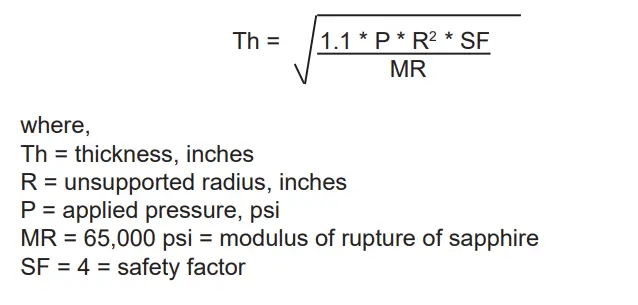
Design of Pressure Windows
The minimum thickness of a window required to withstand applied pressure can be calculated by the following formula:
Sapphire Windows – epoxied
Sapphire windows are mounted in tip counterbores and secured with optically clear epoxy. For static or pulsing pressures, this method has been successfully used up to 30,000 psi.
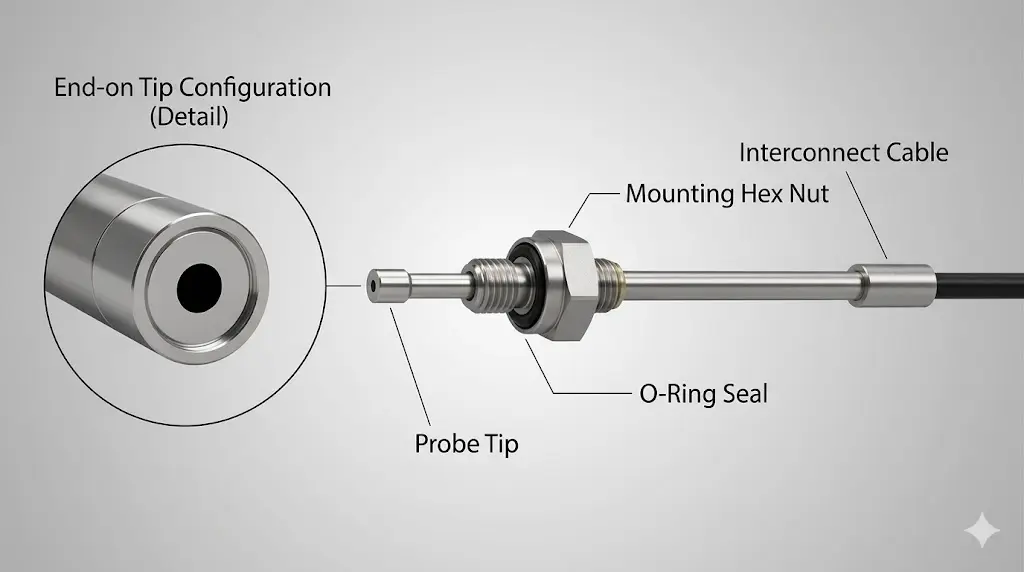
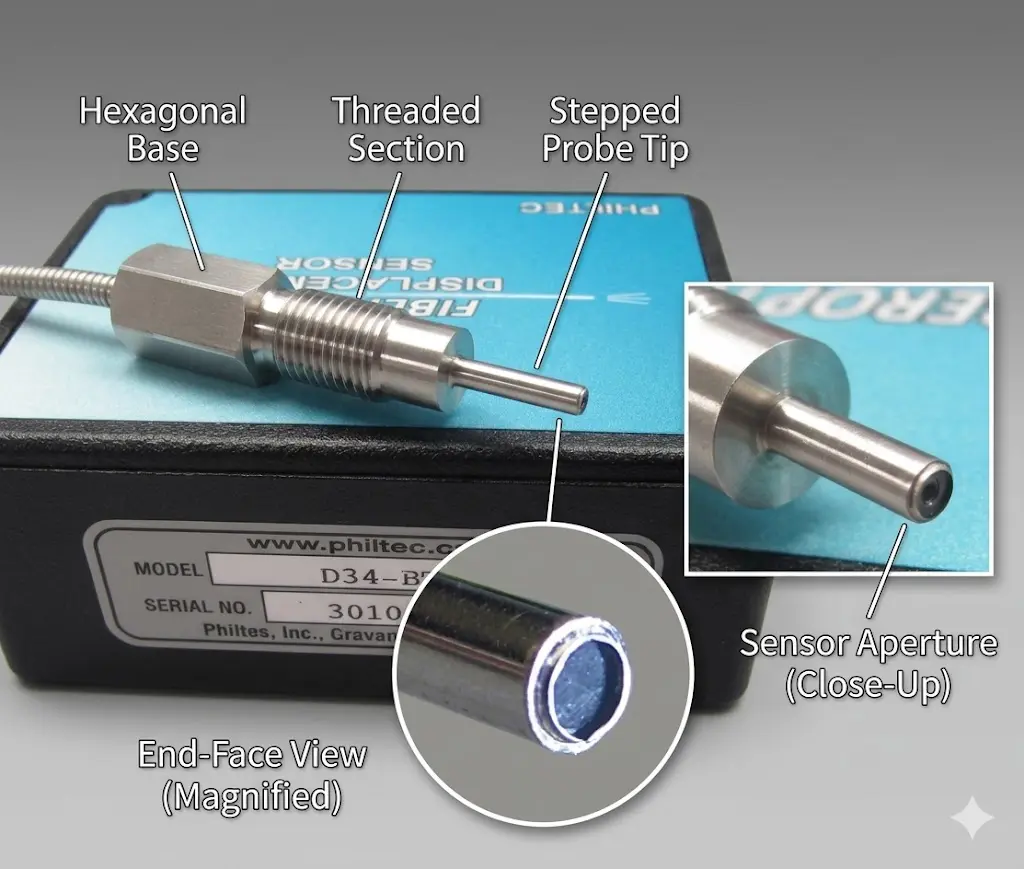
A straight thread o-ring seal compression fitting can be brazed to the probe tip at a prescribed fixed distance from the tip end, and a sapphire window bonded to a ledge inside the probe tip. The window seals the leak path thru the fiberoptics; the fitting seals the leak path around the tip. Anti-Reflection (AR) Coated Windows may be required.
Sapphire Windows – brazed
For special very high pressure applications and for those where there must be zero risk of the window failing or separating from the probe head due to excessive vibrations and heat, sapphire windows can be brazed into tip counterbores. This is the most costly option. Anti-Reflection (AR) Coated Windows may be required.