Blog
See how Philtec fiber optic sensors solve measurement challenges in aerospace, energy, cryogenics, medical technology, vacuum systems, high-pressure environments, and advanced research applications.
Vibration Proof Connectors
For applications where probes and fiber cables are exposed to high vibration levels, we recommend use of a wrench tight connector to make the connection vibration proof.
CONNECTORIZED SENSORS
Where it is desirable to be able to separate the sensor electronics from the measuring probes, fiber optic cables can be connectorized using a simple knurled finger tight design. And damaged tips can easily be replaced. TRANSMIT AND RECEIVE FIBERS ARE SEPARATED AT THE...
Long Length Fiberoptic Cables
PROBLEMQuartz fibers have excellent transmission over long lengths, but they are very expensive and usually cost prohibitive. A recent customer asked for a model D171 sensor with 45 meter length for displacement measurements in vacuum and high magnetic field....
Sensors for Space Telescope Lens Testing
The Euclid Satellite project a good example of Philtec's sensors being used with excellent results in cryogenic conditions. A technical paper published in 2012 shows Philtec’s high precision sensors were successfully used at 150°K to verify the distortion of lens...
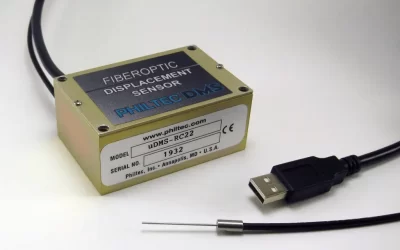
USB Powered Sensors
Introducing our smallest and most powerful...
New Sensor Model for 75 mm Operating Range
Philtec adds the model D240 sensor having an...
Probes for Internal Thread Inspection
The Problem: Inspection of the integrity of...
Blue Light Sensors
INTRODUCING Blue Light Sensors for displacement...
Introducing Wireless Sensing
Philtec has developed an accessory pack...
Welcome to the Philtec Blog
Happy New Year, and welcome to the Philtec blog....